The Virtual Foundry: Company Profile & Capability Statement
Date: February 7, 2026
Location: Stoughton, Wisconsin
Status: Profitable, Independent, Growing
Executive Summary
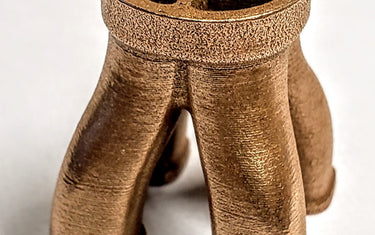
The Virtual Foundry (TVF) is a materials science company based in Stoughton, Wisconsin, that bridges the gap between desktop 3D printing and industrial metallurgy. We are the creators of Filamet™, a patented composite filament that allows standard off-the-shelf FDM printers to produce pure metal, ceramic, and glass parts.
Unlike the "Unicorns" of the additive manufacturing world that burned billions in venture capital only to struggle, TVF has taken the "long game" approach. We are a lean team of fewer than 10 people. We are profitable, growing at 65% (2025), and we answer to our customers, not shareholders. We don’t sell hype; we sell physics.
Origin Story: The Basement & The Struggle
The Virtual Foundry was not born in a boardroom; it started in a basement. In 2014, founder Bradley Woods was recovering from a debilitating illness. Unable to leave his house, he turned to invention as a form of rehabilitation. Working with early 3D printers, he realized the limitations of plastic and began experimenting with metal powders and binders.
The turning point came when Bradley appeared on the local competition "Project Pitch It." While competitors in the industry were raising hundreds of millions in speculative funding, Bradley won a humble $5,000. That check, combined with grit and materials science, built the foundation of the company.
The Hero & The Philosophy
The existence of TVF is credited to Bruce Starkey, an early investor, friend, and mentor who passed away in 2022. Bruce recognized the potential of Bradley’s invention early on but insisted on a strategy that defied modern tech trends:
* Protect the IP: Rigorous patenting of the core technology.
* Stay Independent: Refusing to be diluted by VC money meant we had to be profitable to survive.
Today, we honor Bruce’s legacy by maintaining a >10% profit margin and refusing to sell "snake oil." We are the "David" to the industry’s "Goliaths"—while the giants lay off staff and restructure, we are expanding our capabilities in Stoughton.
Core Capabilities & Technology
Our core technology is an Open-Architecture approach. We do not force customers to buy a $100,000 proprietary printer. If you have a $300 printer and a kiln, you can manufacture metal parts.
The Process (Print, Debind, Sinter)
We are honest about the technical requirements. This is not "push button, get metal." It requires thermal processing expertise.
* Print: Use Filamet™ (Metal powder + Binder) on a standard FDM printer.
* Debind: Heat the part to remove the polymer binder.
* Sinter: Fuse the metal particles just below their melting point.
Note: This process involves shrinkage and requires compensation during the design phase. We provide the data, but the physics are real.
Product Portfolio (Filamet™)
* Standard Metals: Copper, Bronze, 316L Stainless Steel, 17-4 PH Stainless Steel.
* Exotics: Tungsten (Radiation Shielding), Titanium (64-5), Inconel.
* Ceramics & Glass: Silicon Carbide, Pyrex (Borosilicate).
* Rapid 3DShield™: A high-density tungsten solution effectively replacing lead for radiation shielding—printable without sintering.
Market Position & Financial Health (2026)
* Revenue Growth: 65% increase in 2025.
* Profitability: Consistently >10% net profit margins.
* Team Size: <10 Employees. We run lean and efficient.
* Manufacturing: 100% Made in the USA (Stoughton, WI).
Clients & Use Cases
We don't just sell to hobbyists. Our materials are used where supply chains are broken or expensive equipment isn't feasible.
* Defense: U.S. Navy, U.S. Air Force, U.S. Army.
* Research: NASA (including lunar construction research), Department of Energy, and all major National Laboratories (Argonne, Oak Ridge, Sandia, Los Alamos).
* Academia: MIT, Cornell, Carnegie Mellon, and huge adoption in research universities globally.
Risks & Considerations (The Honest View)
The original draft listed "limited financial data" as a risk. We view our privacy as a strength—it ensures stability. The actual considerations for our partners are:
* Sintering is Science: Achieving 99%+ density requires dialing in sintering cycles. We support our customers, but this is a manufacturing process, not a toy.
* Shrinkage: Metal sinters. Sintering shrinks. Parts must be scaled up in the slicer (typically 7-20% depending on the material) to achieve dimensional accuracy.
Contact
* Headquarters: 1471 U.S. Highway 51, Stoughton, WI 53589
* Phone: +1 (608) 509-7146
* Web: thevirtualfoundry.com
* Motto: "We are makers, scientists, and problem solvers. We are The Virtual Foundry."